


Organic food sales break through $60 billion in 2022! Read the press release.
 U.S. Organic Industry Survey 2023
Organic Trade Association’s Organic Industry Survey has been the definitive source for business intelligence on the rapidly growing U.S. organic sector for more than 20 years. If you’re looking for information about the size of the organic market, major players, regulatory developments and key trends, you’ve come to the right place.
Following an unprecedented year marked by pantry loading and supply shortages, the latest Organic Industry Survey shows consumers returned to more stable, buy-as-you-need shopping patterns in 2021.
Each year, OTA brings you the latest research on organic shoppers and retail markets to inform its members, media, government and other communities about the organic trade.
More Resources and Information
 Organic Market Basket
The Organic Market Basket is a data tool from the Organic Trade Association (powered by SPINS) that follows a collection of some of the best-selling organic items in the grocery store. The quarterly snapshot reports average volume sold and price changes of a variety of grocery store items broadly representative of current U.S. organic food sales.
Download the latest Organic Market Basket
 U.S. Organic Hotspots and their Benefit to Local Economies
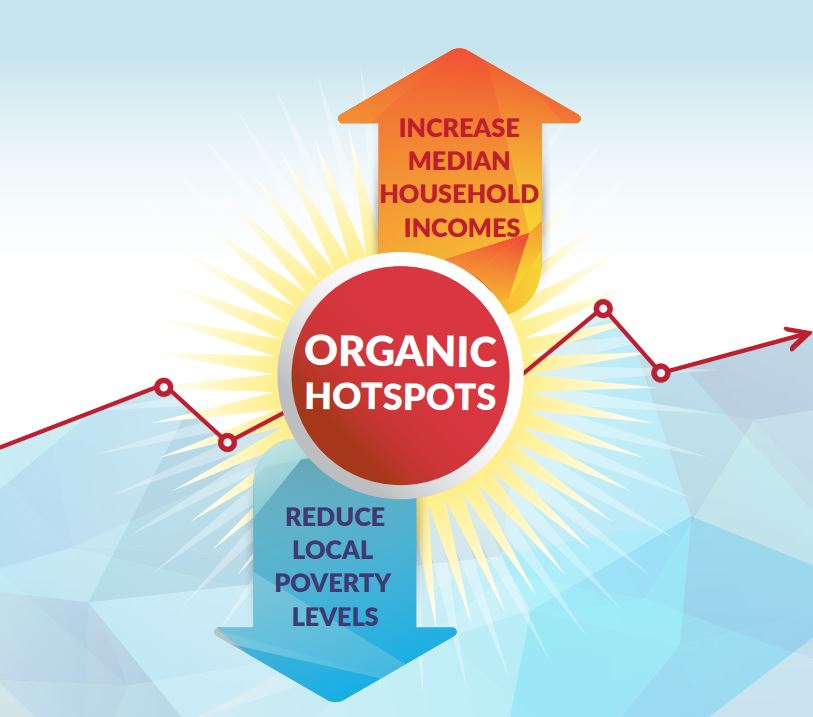
Organic is the fastest growing sector of the U.S. food industry. Organic food sales increase by double digits annually, far outstripping the growth rate for the overall food market. Now, an unprecedented and conclusive study links economic health to organic agriculture. This research identifies 225 counties in the United States in organic hotspots — counties with high levels of organic agricultural activity that have neighboring counties with high organic activity — and then looks at how these organic hotspots impact key county-level economic indicators. Organic Hotspots boost household incomes and reduce poverty levels — and at greater rates than general agriculture activity, and even more than major anti-poverty programs. Being an Organic Hotspot increases median household income by over $2,000 and lowers a county’s poverty rate by as much as 1.35 percentage points.
More Resources and Information
 U.S. Families' Organic Attitudes and Beliefs Survey 2017
More resources and information
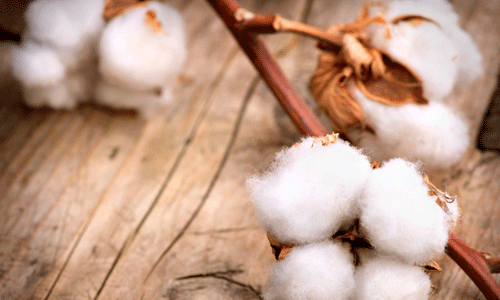 U.S. Cotton Survey 2014
Acres planted to organic cotton decreased by eight percent, from 16,050 acres in 2011 to 14,787 in 2012. However acres harvested increased to 9,842 in 2012—a 60 percent gain over 2011.
8,867 bales were produced in 2012, representing an increase of approximately 22 percent over the prior year.
Commercial availability of organic seed is among the major hurdles for organic cotton producers. However, promising research is being conducted by a team at Texas A&M AgriLife Research in Lubbock, TX on improving organic and non-GM cottonseed, including fiber quality and yields, as well as increased tolerance to drought, pests and weeds.
 U.S. Organic Trade Data Report 2011-2016
This report updates OTA-Penn State report “Preliminary Analysis of USDA’s Organic Trade Data: 2011 to 2014” from April 2015. We analyze data from USDA's Global Agricultural Trade System (GATS) spanning 2011 through 2016 for the values, quantities and prices of organic exports and imports. Product-by-product reports on the top five products of organic exports and imports include information on non-organic product counterparts. This report also includes a comprehensive overview of organic equivalency arrangements in the world and their impacts on organic trade.
Projected growth rates for export products are modest in comparison with the products of organic imports, and the market share of organic imports is higher than for organic exports. Finding that organic soybeans and corn imports exhibit strong growth provides further evidence of the needs for transition of domestic acres to organic production of these commodity crops.
Contact
|
Market Data Inquiries:
CEO
(202) 735-1232
|
Media Inquiries:
(202) 615-7997
|